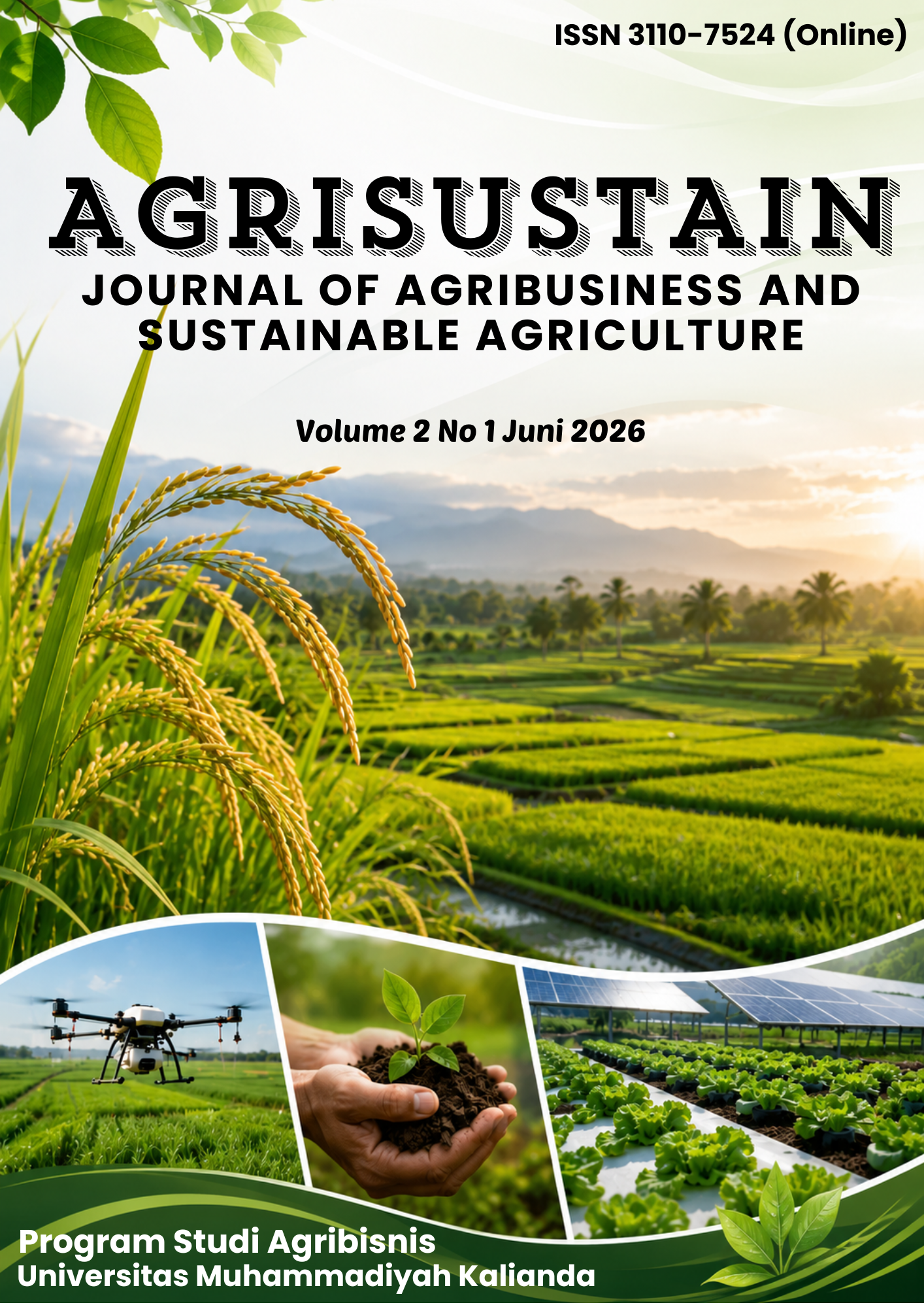
Analisis Kelayakan Usahatani Padi Di Desa Sukatani, Kecamatan Kalianda
DOI:
https://doi.org/10.52655/6c3e6s71Keywords:
Rice Farming, Production Cost, Feasibility, IncomeAbstract
Rice remains the backbone of Indonesia's food security and continues to absorb a large share of rural household labor, yet the actual profitability of paddy cultivation at the farm level is rarely documented at the village scale. The shift toward mechanized harvesting, particularly the growing use of the combine harvester, has also begun to reshape the cost structure that rice farmers face at harvest time. This study sought to measure the cost, revenue, income, profit, and financial feasibility of rice farming among farmers in Sukatani Village, Kalianda Sub-district, South Lampung Regency. A quantitative descriptive method was used, drawing on primary field data recorded directly from farmer respondents during one planting season. The findings indicate that farmers spent an average explicit cost of IDR 761,500 and an implicit cost of IDR 14,655,625, bringing the total production cost to IDR 15,417,125. Average output reached 7,500 kilograms, sold at IDR 6,500 per kilogram, generating revenue of IDR 48,750,000, farm income of IDR 47,988,500, and profit of IDR 33,332,875. The R/C ratio obtained was 3.16, comfortably exceeding the feasibility threshold of one. This result suggests that rice farming practiced by farmers in Sukatani Village is financially sound and worth continuing.
References
Badan Pusat Statistik. (2023). Statistik Pertanian Provinsi Lampung 2023. Badan Pusat Statistik Provinsi Lampung.
Listiana, I., dan Rangga, K. (2020). Respons Petani terhadap Penggunaan Combine Harvester pada Waktu Panen Padi Sawah di Kabupaten Pringsewu Provinsi Lampung. Jurnal Pengkajian dan Pengembangan Teknologi Pertanian 23(3), 259-269.
Nearti, Y., Fachrudin, B., & Awaliah, R. (2020). Analisis Kelayakan Usahatani Padi Sawah (Oryza sativa) Tadah Hujan (Studi Kasus di Desa Sungai Dua Kecamatan Rambutan Kabupaten Banyuasin). Jurnal AGRIPITA 4(2), 61-67.
Rustam, W. (2014). Analisis Pendapatan dan Kelayakan Usahatani Padi Sawah di Desa Randomayang Kecamatan Bambalamotu Kabupaten Mamuju Utara. e-J Agrotekbis 2(6), 634-638.
YH, A. A. S., Harlianda, T. K., & Safitri, A. (2025). Faktor-Faktor Yang Mempengaruhi Produksi Padi Di Kecamatan Kalianda, Lampung Selatan. Agripreneur: Jurnal Pertanian Agribisnis, 14(2), 119-127. https://doi.org/10.35335/agripreneur.v14i2.6637
Soekartawi. (2011). Ilmu Usaha Tani. Jakarta: Universitas Indonesia.
Sulistyanto, G. D., Kusrini, N., & Maswadi, M. (2019). Analisis Kelayakan Usahatani Tanaman Padi di Kecamatan Sebangki Kabupaten Landak. Jurnal Sains Pertanian Equator 2(3), 1-10.
Suratiyah, K. (2015). Ilmu Usahatani. Jakarta: Penebar Swadaya.
Sutarni dan Fitri, A. (2023). Analisis Kelayakan Finansial Usahatani Padi Sawah tanpa Pestisida Kimia. Agro Bali: Agricultural Journal 6(1), 218-230.